
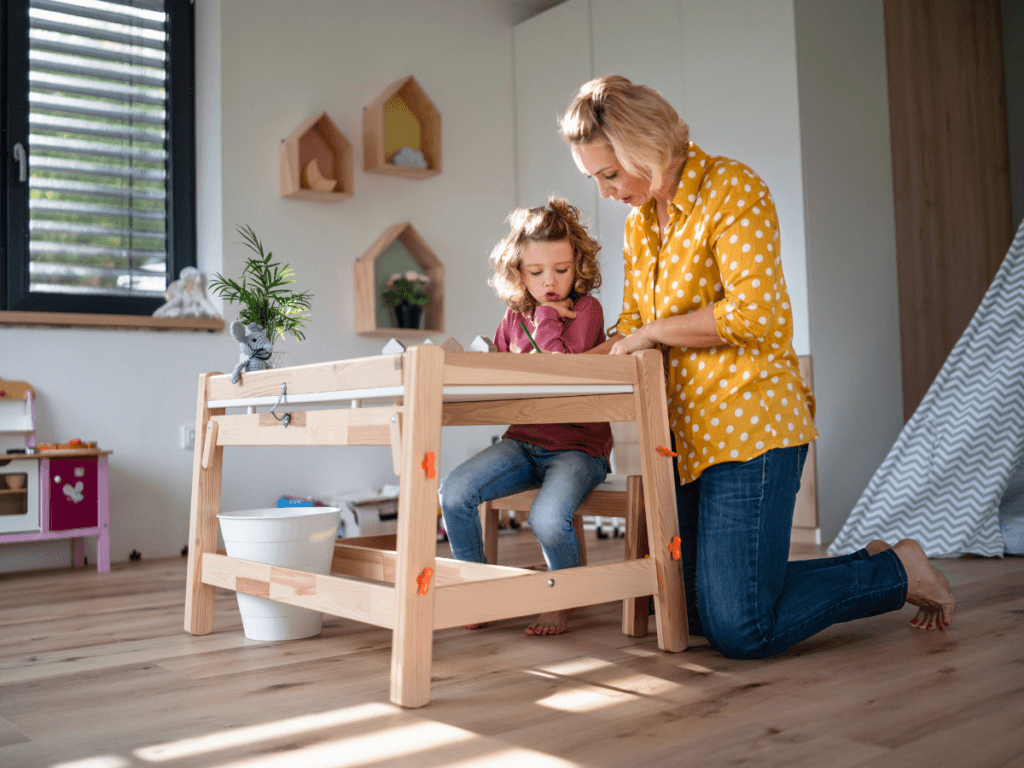
Modeling strength, confidence, and longevity through action.
The front door opens at 3:47 PM.
Backpacks drop onto hardwood.
Lunchboxes land on the counter.
Voices fill the kitchen all at once.
“Mom, can you help me with this?”
“Watch what I learned today.”
“Can we go outside?”
They are not just looking for snacks.
They are looking at you.
Not consciously.
But constantly.
Children copy posture.
They copy habits.
They copy your attitude toward discomfort.
And in these ordinary after-school moments, they are forming their understanding of what adulthood looks like.
What Children Notice
They notice the small pauses.
You shift your weight before standing up from the chair.
You brace your lower back when lifting a backpack.
You say, casually, “My knee’s been acting up.”
They see when you avoid sitting on the floor to build the Lego tower.
They hear when you joke, “I’m getting old.”
To them, this becomes the script.
Research in behavioral modeling consistently shows that children internalize parental movement behaviors. Not just activity levels, but how parents respond to physical discomfort.
If pain is ignored or normalized as inevitable, they absorb that.
If strength and proactive care are normalized, they absorb that too.
Patterns are quiet.
But they are powerful.
The Intergenerational Effect of Strength
Long-term studies show that active parents significantly increase the likelihood of raising active children. Not because they talk about exercise.
Because they demonstrate it.
Movement confidence transfers.
So does movement avoidance.
When a mother moves fluidly—kneels, lifts, rotates, carries—children associate adulthood with durability.
When she avoids certain motions due to untreated pain, children associate adulthood with limitation.
Addressing discomfort early changes that trajectory.
Lower back pain treatments, for example, focus on restoring hip mobility, improving core stability, and correcting lumbar loading patterns. When mechanics improve, pain often resolves because strain decreases.
A comprehensive knee pain physical therapy treatment rarely isolates the knee. It examines glute strength, ankle mobility, and alignment strategies built over years.
This is biomechanics.
It is measurable.
It is modifiable.
The Skillz Philosophy
At The Leading Expert-led Physical Therapy Clinic in Evanston, care is not built around aesthetics.
It is not punishment-based.
It is not trend-driven.
It is built around:
Your capability.
Your goals.
Your autonomy.
An expert-led physical therapy clinic like Skillz PT reduce more than symptoms. We restore trust in your own body.
When women search for physical therapy evanston il or physical therapy skokie, they are often searching for answers. They want clarity about what is happening. They want to know whether it will worsen. They want a structured plan.
A complete and thorough evaluation comes first.
Movement analysis & education comes next.
Targeted intervention follows.
Lower back pain treatments are individualized because no two loading patterns are identical. Knee pain physical therapy treatment plans are built from objective findings, not generic protocols.
This protects long-term function.
It protects independence.
It protects the example being set in the kitchen at 3:47 PM.
“Your children are watching how you treat your body. That becomes their blueprint.”
The strongest message you send is not verbal.
It is physical.
Not intensity.
Not perfection.
Capability.
Take Action Today
Set the strongest example for your kids. Restore your mobility, reduce pain, and build lasting strength.
Book your expert physical therapy session at Skillz PT in Evanston & Skokie today. Your kids are watching—and learning.
Tags: Expert-Led Physical Therapy Clinic, physical therapy Evanston IL