
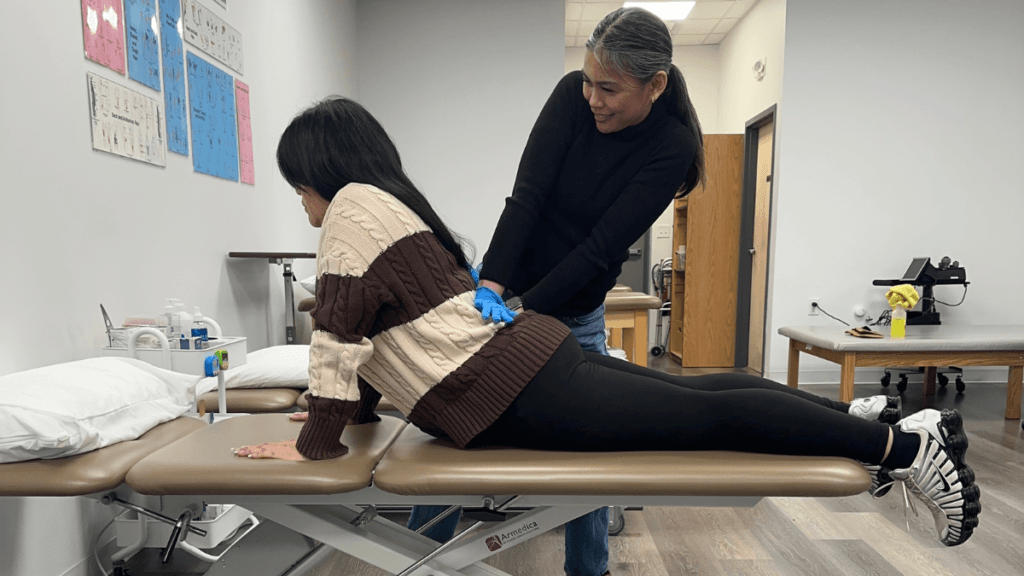
Usually, no. Most people can start physical therapy for lower back pain without an MRI if their symptoms and a thorough evaluation from a knowledgeable physical therapist show no signs of a serious medical problem.
However, imaging may be necessary when there’s concern about a fracture, infection, cancer, or significant nerve problems. New loss of bladder or bowel control, numbness around the groin, or rapidly worsening leg weakness requires immediate emergency medical attention.
For uncomplicated back pain, clinical guidelines recommend an appropriate examination rather than routine imaging. An MRI is generally considered when its findings could change medical treatment.
Source: NICE Guidelines for Low Back Pain and Sciatica.
What If Your MRI Shows Something Wrong, but You Have No Pain?
Here’s something researchers discovered that might surprise you.
In a 2015 systematic review, researchers examined spinal imaging findings from 3,110 people who had no back pain.
They found that disc degeneration was remarkably common, even among people without symptoms.
| Age | People with disc degeneration |
| 40 | 68% |
| 50 | 80% |
| 60 | 88% |
Estimated percentages from the research, which included MRI and CT imaging studies.
At age 50, approximately 8 out of 10 people without back pain showed disc degeneration on spinal imaging.
Does that mean disc problems never cause pain? Of course not.
In fact, another systematic review found that certain spinal changes were more common in people experiencing back pain than in those without symptoms.
The important distinction is that finding an abnormality on an MRI doesn’t automatically prove it’s responsible for your pain.
That’s why imaging results need to be considered alongside your symptoms and a thorough physical examination from a knowledgeable physical therapist.
How Can a Physical Therapist Evaluate Back Pain Without an MRI?
An MRI provides detailed pictures of your spine, but it cannot show how your symptoms respond when you move.
A physical examination helps answer questions such as:
- Does bending forward make your symptoms better or worse?
- Does pain travel from your back into your leg?
- Are there changes in strength, sensation, or reflexes?
- Could your hips or other areas be contributing to the problem?
For example, when someone has back pain traveling into their leg, a physical therapist may examine nerve function and compare how symptoms respond to different movements.
These findings can help determine whether the symptoms are consistent with nerve irritation, a movement-related problem, or another condition requiring medical attention.
At Skillz Physical Therapy in Evanston, our PinPoint Evaluation examines these findings together. We look at the painful area and relevant contributing regions, explain what the examination suggests, and use those findings to guide the next step.
An examination doesn’t always identify one exact source of pain. When the findings are unclear or suggest a medical concern, further evaluation may be necessary.
When Should You Actually Get an MRI?
An MRI or other imaging may be appropriate when:
- A serious condition is suspected, such as a spinal infection, cancer, or fracture.
- Neurological symptoms are significant or worsening, particularly when accompanied by weakness.
- Back pain or sciatica persists despite appropriate treatment, and imaging could guide a procedure, surgery, or another important medical decision.
Some warning signs require prompt medical assessment rather than waiting for a physical therapy appointment. These include fever with concerning back pain, significant trauma, or new back pain in someone with a history of cancer.
Not every concerning symptom requires an MRI specifically. A medical professional should determine which investigation is appropriate.
The American College of Radiology recommends imaging in selected circumstances, including certain patients with persistent or worsening symptoms after approximately six weeks of appropriate care when surgery or another intervention is being considered.
The question is whether an MRI will help make a better treatment decision.
What If You Already Have an MRI Showing a Herniated Disc?
A herniated disc doesn’t automatically mean you need surgery or that physical therapy is inappropriate.
Many people with disc-related back pain or sciatica can begin with conservative care.
If you already have an MRI, bring the report to your evaluation. Our physical therapist can consider those findings alongside your symptoms, movement, and neurological examination.
And if you’ve already tried physical therapy without meaningful improvement, the next step may be reassessing the problem rather than repeating the same treatment.
Related reading: Physical Therapy Didn’t Help My Back Pain: What Should Be Rechecked?
Understanding Your Back Pain Starts With an Evaluation
An MRI can provide valuable information when it’s medically necessary. But for many people, a thorough clinical examination is an appropriate first step.
At Skillz Physical Therapy in Evanston, IL, our PinPoint Evaluation is designed to help you understand what your examination reveals, what may be contributing to your pain, and which next steps make sense.
Learn more about the PinPoint Evaluation and schedule your visit.
Serving Evanston, Wilmette, Skokie, Rogers Park, and nearby North Shore communities.
Clinical references: NICE Low Back Pain Guidelines | American College of Radiology | Brinjikji et al., 2015 (asymptomatic individuals) | Brinjikji et al., 2015 (symptomatic versus asymptomatic)
Prepared by: Skillz Physical Therapy Editorial Team
Clinical review: Aime Maranan, PT, CMTPT, Cert. MDT, Founder and Lead Physical Therapist
Updated: November 19, 2026
This article is for educational purposes and does not replace individualized medical advice.
Tags: Back Pain Diagnosis, Herniated Disc, Low Back Pain, MRI Before Physical Therapy, Physical Therapy Evaluation