
Why the outside of your hip may ache at night, why stretching may not help, and how an evaluation can guide your next step.
You turn onto your other side to take the pressure off your sore hip. A few minutes later, that same hip still aches. Now you are rearranging pillows and wondering how you are supposed to get comfortable enough to sleep.
If this sounds familiar, there is a reasonable question to ask: Why does my hip hurt even when I am not lying on it?
One possible explanation involves the tendons along the outside of your hip. Lying directly on that side can compress sensitive tissues. Turning over can also bother them if the upper leg drops inward across your body. Understanding which positions provoke the pain helps guide what to examine. It does not establish a diagnosis on its own. [1]
What can cause pain on the outside of the hip?
Gluteal tendinopathy affects tendons that connect your buttock muscles to bone near the outer hip. It is an important consideration in women around and after menopause. However, age and hormonal changes do not tell us what is causing an individual person’s pain. [2]
You may also hear the term greater trochanteric pain syndrome, or GTPS, used to describe pain involving the tissues around the bony outer hip. Symptoms can include tenderness in this area and discomfort with stairs, standing on one leg, or lying on your side. [3]
People often call outer-hip pain “bursitis.” A bursa is a small fluid-filled sac that helps reduce friction. Bursa irritation can occur, but the nearby tendons may also be involved. Arthritis and pain referred from the spine are other possibilities. These explanations require different treatment decisions, which is why identifying the painful spot is only the beginning. [2]
Is outer-hip pain different from groin pain?
Location provides a clue. It does not provide the whole answer.
Pain over the outside of the hip, especially with pressure or side sleeping, can fit a tendon-related problem. [3] Hip osteoarthritis more commonly causes pain in the groin, although it can also spread into the thigh, buttock, or knee. Stiffness and difficulty moving the hip can accompany it. [4]
Pain patterns overlap. The purpose of an examination is to compare those clues with your history, movement, and response to testing, rather than assign a diagnosis from a diagram.
Why can lying on either side hurt?
If your right outer hip is sore, lying on your right side presses directly on that area. But lying on your left side can let your right knee fall forward and downward. That position can increase compression around the right outer-hip tendons. [1]
This can explain why simply turning over fails to solve the problem. It does not necessarily mean both hips are injured.
For comfort, you can try:
- Lying on your back, if that position works for you.
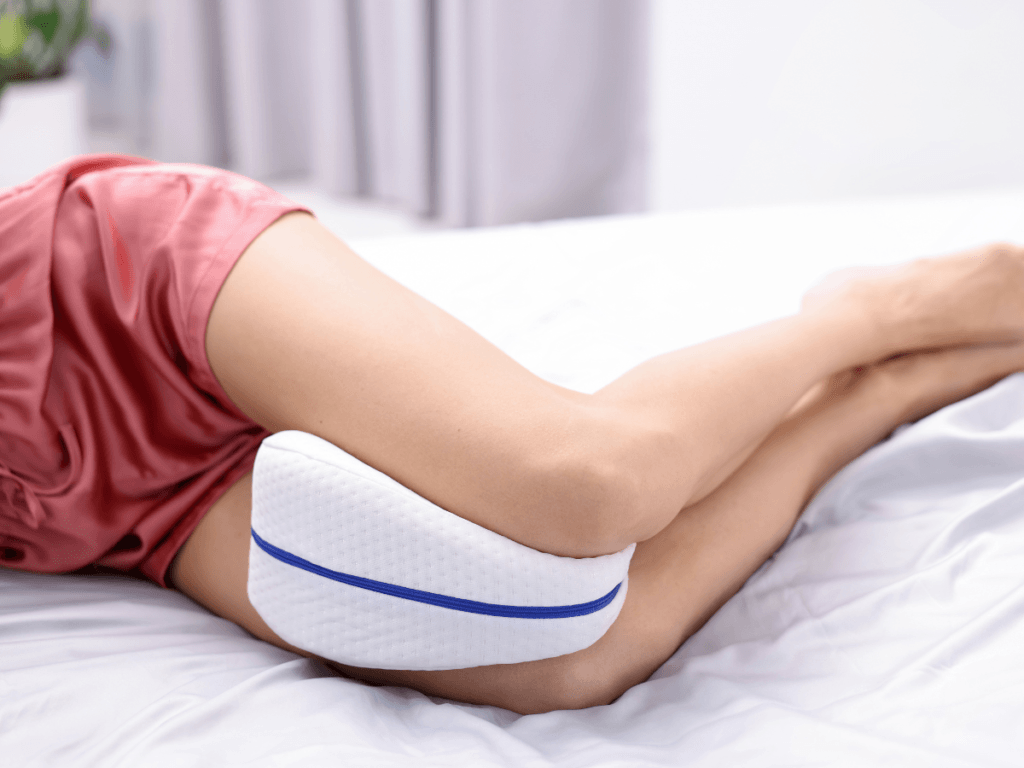
- Lying on the less painful side with a pillow supporting the upper leg, so it does not drop inward. Support between the knees and ankles may help.
- Changing positions if discomfort increases, instead of forcing yourself to remain in one sleeping posture. [1,2]
A more comfortable position can make resting easier. It does not tell us which tissue is responsible or replace an assessment when symptoms persist.
Why isn’t stretching fixing it?
Feeling tight can make stretching seem like the obvious answer. But with gluteal tendinopathy, flexibility may not be the main issue. Repeated stretching alone does not address how the tendon tolerates the demands placed on it. [2]
For tendon-related outer-hip pain, management commonly includes reducing aggravating positions and gradually building strength. [3] That is different from repeatedly pulling harder on the area because it still feels uncomfortable.
If a stretch repeatedly leaves you more sore, tell your clinician what happens during it and afterward. That response is useful information when deciding what to change.
What treatment has evidence behind it?
A randomized trial published in the BMJ studied 204 adults with persistent, confirmed gluteal tendinopathy. It compared education about managing tendon load plus exercise, a corticosteroid injection, and a wait-and-see approach. [5]
At eight weeks, education plus exercise produced better overall improvement and lower pain than the injection group. At one year, overall improvement still favored education plus exercise, but pain intensity did not differ significantly between those two groups. [5]
The practical message is that understanding how to manage daily demands belongs alongside a progressive exercise plan. The trial does not mean every person with hip pain needs the same exercises, or that an injection is never appropriate. It studied a defined condition, not every possible source of hip pain.
What would an evaluation at Skillz look for?
At Skillz Physical Therapy in Evanston, our thorough 60-mins Evaluation asks whether the painful area itself is responsible or whether another region is contributing to your symptoms.
For outer-hip pain, we consider the pattern across sleep, walking, stairs, and other activities. We compare local examination findings with movement and symptom responses to help distinguish a hip-related problem from pain coming from elsewhere.
The question is not simply whether a muscle is weak or a spot is tender. We want to understand whether the findings fit your symptoms and give us a clear reason for the treatment we select.
We explain what the findings suggest, use them to guide care through our AIM Method, and reassess your response as treatment progresses. If the findings suggest you need medical assessment beyond physical therapy, we explain that next step.
Get help understanding what is disturbing your sleep
When you contact us, tell us which side hurts, which sleeping positions bother it, and whether walking or stairs bring on the same pain. Those details help us understand what you need assessed.
If outer-hip pain keeps interrupting your nights, contact Skillz Physical Therapy in Evanston to schedule a thorough 60-mins Evaluation. We will explain what the findings suggest and discuss the next steps for your care.
We welcome patients from Evanston, Wilmette, Skokie, and Rogers Park.
Sources
- East Lancashire Hospitals NHS Trust: Pain on the outside of the hip.
- Hospital for Special Surgery: What Is Gluteal Tendinopathy and Why Is It Common in Women?. Published January 29, 2024.
- Kingston and Richmond NHS Foundation Trust: Greater trochanteric pain syndrome. Updated December 9, 2024.
- American Academy of Orthopaedic Surgeons: Hip Osteoarthritis.
- Mellor et al. Education plus exercise versus corticosteroid injection use versus a wait and see approach on global outcome and pain from gluteal tendinopathy. BMJ. 2018;361:k1662.