
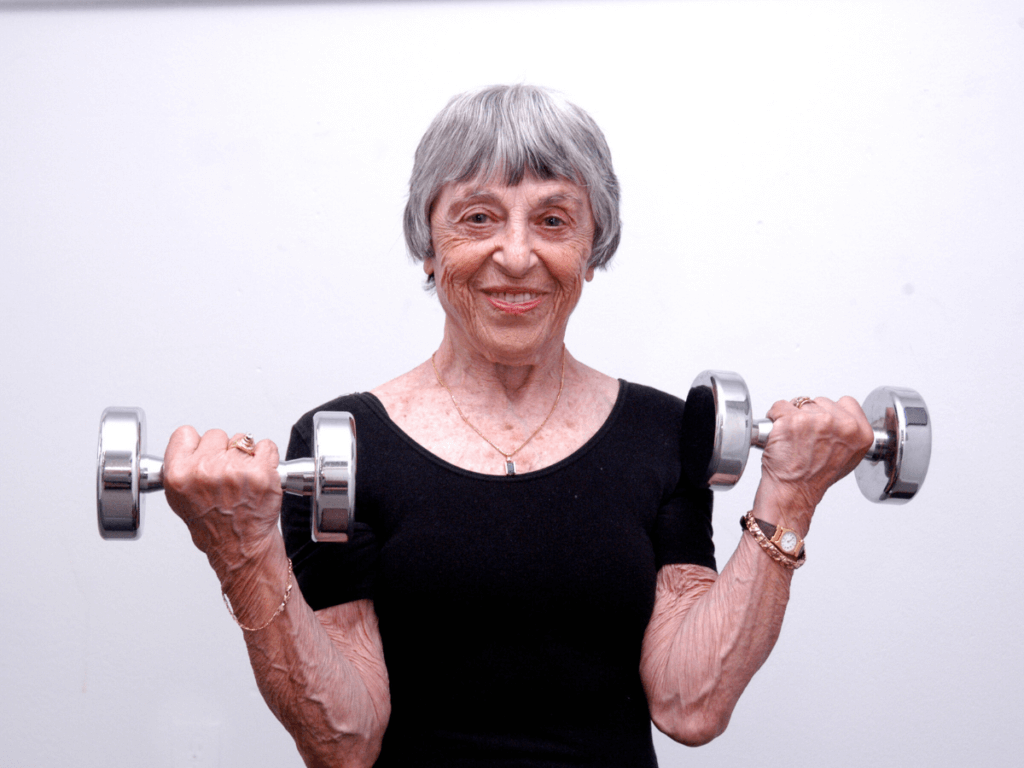
After 60 It’s Not About Lifting More. It Is About Losing Less
There was a time when lifting something heavy did not require strategy.
You reached, you lifted, and you moved on.
Now, before picking up groceries or shifting a full laundry basket, you pause.
- You brace.
- You position your feet.
- You calculate.
That is awareness.
And awareness is often the first sign that muscle is changing.
Many women quietly wonder:
“Isn’t strength training for younger people?”
It is a fair question.
It is also built on an outdated assumption.
After 60, strength training is not about performance.
It is about preservation.
What Happens to Muscle After 60
Beginning in the fifth and sixth decades of life, the body undergoes a gradual process known as age-related muscle loss. Clinically, this is called sarcopenia.
It does not happen overnight.
It happens quietly.
Muscle fibers decrease in size.
Neuromuscular coordination becomes less efficient.
Reaction time slows.
Without intervention, adults can lose up to 1–3 percent of muscle mass per year after midlife. The result is not just reduced strength. It is reduced resilience.
Muscle is not cosmetic tissue.
It is protective tissue.
- Strong hips stabilize knees.
- Strong glutes unload the lower back.
- Strong shoulders protect the neck.
When muscle weakens, joints absorb more stress. Cartilage wears faster. Tendons strain more easily. Balance becomes less predictable.
This is why targeted lower back pain treatments and structured knee pain physical therapy treatment programs often begin with strength restoration rather than passive stretching alone.
Strength Is Joint Protection
There is a common misconception that joint pain means you should avoid loading the area.
In reality, properly dosed loading is often therapeutic.
When muscles surrounding a joint are strong:
• Knees track more efficiently
• Hips absorb force instead of transferring it to the spine
• Shoulders maintain better alignment
• Bone density receives stimulus
Bone responds to stress. Without resistance, bone mineral density declines. This contributes to osteopenia and osteoporosis.
Strength training is one of the most researched non-pharmacological strategies for maintaining bone health after 60.
It is not aggressive lifting.
It is controlled, progressive resistance.
And it is safest when structured correctly.
What Safe Strength Training Actually Looks Like
It rarely starts with heavy barbells.
It often begins with:
• Sit-to-stand repetitions from a chair
• Wall-supported squats
• Resistance band rows
• Light dumbbell presses
• Step-up drills
• Guided balance work
The goal is not exhaustion.
The goal is adaptation.
At an expert-led physical therapy clinic, progression is methodical. Load increases gradually. Form is monitored. Joint tolerance is respected.
This is particularly important for women managing:
• Chronic knee discomfort
• Recurrent shoulder tightness
• Lumbar stiffness
• Early bone density changes
In clinical environments offering physical therapy evanston il and physical therapy skokie, programs are individualized to medical history, mobility level, and long-term goals.
Strength work is not copied from a generic class.
It is prescribed.
How Strength Reduces Pain
Pain often reflects overload, not damage.
When muscle is weak:
• Knees collapse inward during stairs
• The lower back compensates during lifting
• Shoulders elevate and strain during reaching
Strength corrects the mechanical environment.
For example:
Strengthening the gluteal muscles reduces knee valgus stress, which decreases medial knee strain.
Targeted hip strengthening offloads lumbar segments during bending.
Scapular stabilization improves shoulder mechanics and reduces impingement symptoms.
This is why structured strength programming is foundational inside The Leading Expert-led Physical Therapy Clinic in Evanston.
Pain relief is not achieved by avoiding movement.
It is achieved by improving movement capacity.
The Psychological Shift
There is another layer that research increasingly highlights.
Strength training improves confidence.
When a woman trusts her legs, she walks farther.
She trusts her balance, she attends more social events.
When she trusts her back, she travels without fear of flare-ups.
Strength becomes behavioral freedom.
And behavioral freedom protects independence.
Local Options for Getting Started
For women in Evanston and surrounding communities, options include:
• Small group strength classes at community centers
• Senior-focused resistance programs
• Guided training sessions inside clinical environments
• Individualized rehabilitation-based strength programs
The advantage of beginning within a structured clinical setting is assessment.
An expert evaluates:
• Joint mobility
• Muscle activation patterns
• Balance integrity
• Bone health risk
• Pain triggers
That evaluation determines dosage.
Not guesswork.
Not trends.
Clinical reasoning.
Strength as Independence Insurance
After 60, strength training is not about chasing youth.
It is about protecting routine.
Carrying groceries without hesitation.
Walking along the lake without planning exit routes.
Getting up from the floor without assistance.
Muscle does not disappear because of age alone.
It declines because it is no longer challenged.
The body still adapts.
It simply requires intention.
Strength training is not for younger people.
It is for people who intend to keep living fully.
Take Action Today
Don’t wait—schedule your guided strength session at Skillz Physical Therapy today and start protecting your independence, mobility, and confidence.